
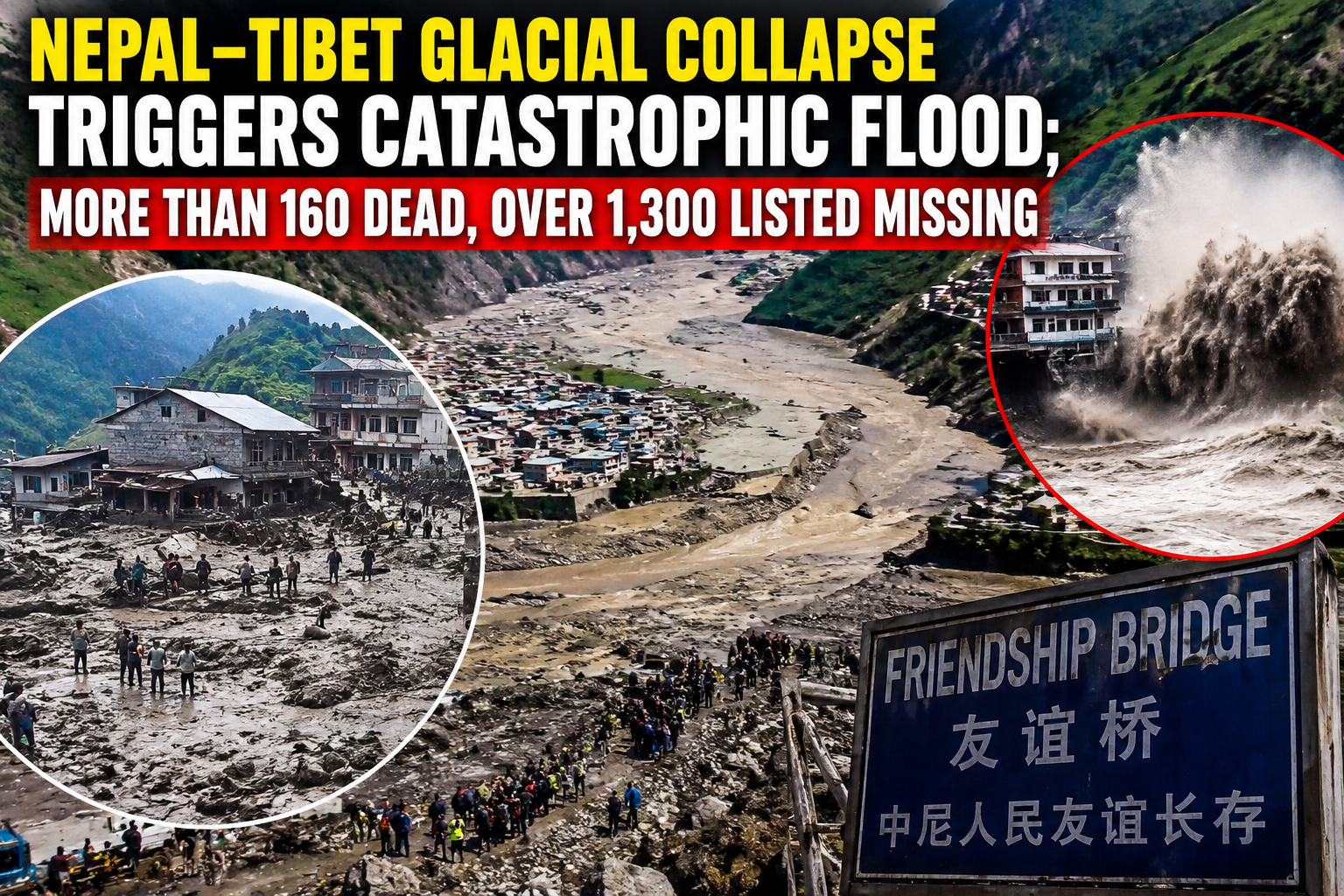
Entire villages, border settlements and roads have been swept away after a torrent of water, ice, mud and rock thundered through Himalayan valleys. Hundreds of foreign tourists and pilgrims are among those still unaccounted for.
A catastrophic glacial collapse has triggered one of the deadliest Himalayan disasters in recent years, sending a vast wall of water and debris through communities near the Nepal–Tibet border.
The disaster unfolded on the morning of Wednesday, August 26, 2026, when a high-altitude mass of ice and rock apparently collapsed into the Lhende Khola river system. The impact produced a powerful downstream surge that tore through valleys, destroyed settlements and buried homes and vehicles beneath thick mud.
By Thursday morning, Nepalese government figures said 165 bodies had been recovered in Nepal, while Chinese authorities reported at least three deaths in Tibet. More than 1,300 people appeared on missing-person lists compiled separately by officials in Nepal and Tibet, although authorities had not determined whether some names appeared on both lists. The casualty figures remain provisional and are expected to change as rescue workers reach isolated locations. 1
A Wall of Water Sweeps Through Himalayan Communities
Videos recorded near the border showed people running as an enormous surge of brown water, mud and rocks crashed through the valley. Buildings collapsed within moments, trucks were overturned and entire stretches of road disappeared beneath the flood.
The water moved rapidly through the Bhote Koshi and Trishuli river systems, affecting communities in Rasuwa, Nuwakot and Dhading. Houses, marketplaces, trees, hydropower facilities and vehicles were either swept away or buried.
According to the International Centre for Integrated Mountain Development, or ICIMOD, the Trishuli River reportedly rose by approximately nine metres at Galchhi in just 30 minutes. At Malekhu, the river level increased by about seven metres over a similar period, demonstrating the extraordinary speed and scale of the flood. 2
Residents had almost no time to escape.
Survivors described hearing a powerful roar before seeing a rising wall of mud approaching their homes. One labourer reportedly survived after being carried downstream and grabbing hold of a tree. Another man was rescued by helicopter after losing his wife when floodwater entered their house and swept her away. 1
Hundreds of Tourists and Pilgrims Missing
The disaster struck a major travel corridor connecting Nepal with Tibet. The region is regularly used by trekkers, tourists, cross-border workers and religious groups travelling toward Kailash Mansarovar.
Latest figures cited by Reuters indicated that 826 people were missing in Nepal, including nearly 600 foreign nationals. Among those listed as unaccounted for were 177 people from India, 63 from the United States, 34 from Australia, 33 from Britain and 25 from Canada. 1
Chinese state broadcaster CCTV reported another 558 people missing in Tibet’s Gyirong county, including approximately 260 foreign nationals. Because travellers may have been moving across the border when the flood struck, officials warned that the Nepalese and Chinese records could overlap. 3
Many of the missing travellers were believed to be participating in pilgrimages to Mount Kailash and Lake Mansarovar. The remote high-altitude area holds deep religious importance for Hindus, Buddhists and followers of other faiths.
The involvement of international tourists has turned the disaster into a global emergency. Diplomatic officials from India, the United States, Australia, Britain, Canada and several other countries are working to confirm the locations and safety of their citizens.
Was the Flood Caused by an Earthquake?
Early reports suggested that a magnitude 4.4 earthquake might have triggered the disaster. However, the US Geological Survey later concluded that the seismic signal was not produced by a conventional earthquake.
According to its updated assessment, the signal came from the enormous collapse of glacial ice and rock, followed by a high-energy debris flow. The event was subsequently classified as a magnitude 5.2 glacial collapse, with the agency stating that no earthquake had occurred. 4
Preliminary satellite analysis suggests that ice and rock fell into the Lhende Khola, a tributary of the Bhote Koshi. The material may have temporarily blocked the river before releasing a sudden and devastating surge of water, sediment and boulders.
ICIMOD has nevertheless urged caution, saying an ice-rock avalanche is the suspected trigger but that scientific investigations are continuing. Experts are analysing satellite imagery, hydrological observations, seismic records and information collected from affected communities. 2
Fears of a Second Flood
Rescue operations are taking place under extremely dangerous conditions.
Scientists and authorities have identified a possible blockage upstream from the devastated border crossing. If water continues accumulating behind the natural barrier, its sudden failure could produce another destructive flood.
Evacuations have consequently been ordered in areas considered at risk, while Chinese authorities have increased monitoring around a dammed lake upstream. Emergency teams are also watching river levels and geological activity for signs of a secondary disaster. 3
The warning has complicated the search for survivors. Rescue personnel must enter unstable valleys filled with damaged roads, loose debris, deep mud and collapsed structures while remaining prepared to evacuate if another surge develops.
Massive Rescue Operation Underway
More than 5,000 army and police personnel have reportedly been mobilised in Nepal. Helicopters are searching remote valleys, rescuing stranded residents and delivering food, tents, medicine and other emergency supplies to communities cut off by damaged roads. 1
On the Tibetan side, fire and rescue teams from Beijing and Chengdu have joined local police and emergency workers. Boats, vehicles, earthmoving machinery and search dogs are being used to reach areas buried beneath mud and rock. 3
Electricity and mobile communications remain disrupted in several locations because power projects, transmission infrastructure and roads were damaged. Families have gathered near rescue bases and government offices, desperately seeking information about missing relatives.
The United Nations and international humanitarian organisations are coordinating with Nepalese authorities. The United States has also announced $500,000 in emergency assistance, while neighbouring India has provided relief supplies for communities affected by the flooding. 1
Disaster Highlights Growing Himalayan Risks
The Nepal–Tibet tragedy has renewed concerns about the vulnerability of Himalayan communities to glacier-related hazards.
The steep landscape can transform an avalanche or glacial collapse into a fast-moving flood within a short period. Water, sediment and boulders accelerate through narrow valleys, leaving downstream communities with little warning or time to evacuate.
The Lhende Khola river system has now experienced two destructive floods in approximately 14 months. A previous flood in the region in 2025 was linked to the sudden drainage of a supraglacial lake in Tibet and damaged critical infrastructure connecting Nepal and China. 4
Scientists say climate change is altering glaciers, permafrost, snow conditions and mountain slopes throughout the Hindu Kush Himalaya. However, ICIMOD has stressed that it is still too early to determine exactly how climate change contributed to this particular collapse. 2
The recurring disasters underline the need for improved satellite monitoring, cross-border warning systems, evacuation planning and real-time communication between Nepal and China. Because Himalayan rivers cross national boundaries, an event beginning in one country can devastate communities in another within hours.
Search for Survivors Continues
For the families of those missing, every passing hour brings greater uncertainty. Rescue teams are continuing to examine riverbanks, collapsed buildings, mud-covered settlements and debris fields stretching far downstream.
Authorities have warned that the death toll could rise substantially as teams enter previously inaccessible areas. At the same time, officials are checking shelters, hospitals and stranded travel groups in the hope that some of those listed as missing are alive but unable to communicate.
As of Thursday, August 27, 2026, the situation remains fluid. The immediate priorities are finding survivors, delivering emergency assistance and protecting downstream communities from the possibility of another flood.
The scale of the destruction has transformed once-busy villages and travel routes into landscapes of mud and debris. Across Nepal, Tibet and the countries whose citizens remain missing, families are now waiting for news from one of the most challenging rescue operations the Himalayas have witnessed in years.