
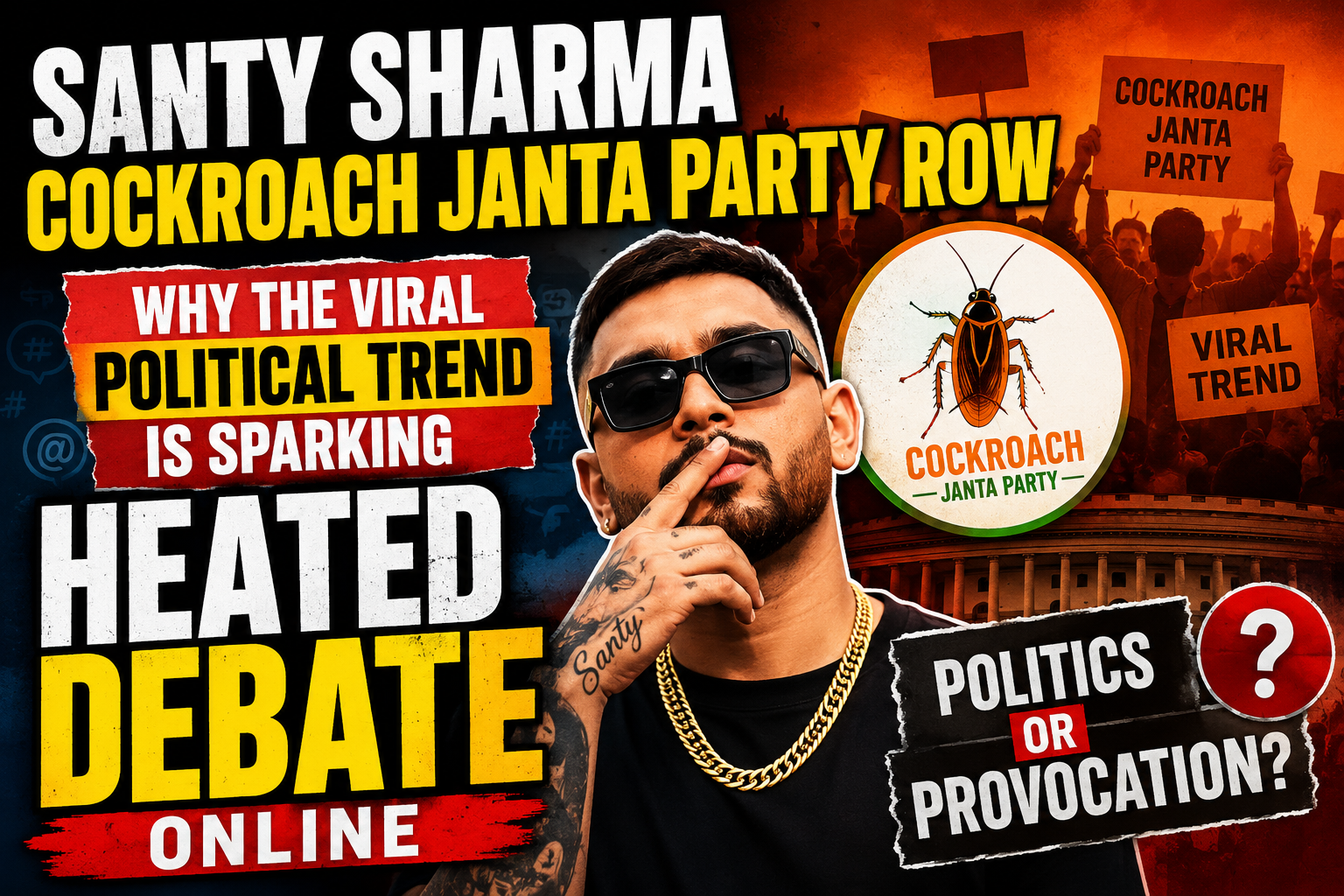
The Indian internet has once again found itself at the center of a political storm — but this time, it’s not a traditional party rally or a heated TV debate grabbing attention. Instead, it’s a social media-driven movement called the Cockroach Janata Party (CJP) that has exploded across Instagram, X, and YouTube. And now, independent rapper Santy Sharma has stepped into the spotlight with blunt criticism that has fueled even more online conversations.
The phrase “rapper santy sharma cockroach janta party” has quickly become one of the most searched topics online as users try to understand why the artist openly called the movement “internet drama” instead of a serious political revolution.
So, what exactly is happening here? Why are young Indians suddenly talking about a party with such an unusual name? And who is Santy Sharma, the rapper now making headlines for his outspoken comments?
Let’s break it all down.
What Is the Cockroach Janata Party?
The Cockroach Janata Party, commonly referred to as CJP, emerged in May 2026 as an unexpected political phenomenon on Indian social media. Founded by America-based Abhijeet Dipke, the party rapidly gained online traction among Gen Z users, meme creators, digital activists, and politically frustrated youth.
Unlike traditional political campaigns that rely heavily on rallies and television promotions, CJP’s popularity spread through reels, hashtags, memes, livestreams, and viral social media interactions. Within days, thousands of users reportedly filled out membership forms and publicly declared support online.
The name itself — “Cockroach Janata Party” — immediately triggered curiosity. Cockroaches are often associated with survival and resilience, and supporters interpreted the symbolism as a representation of ordinary citizens surviving within a corrupt political ecosystem.
Sounds dramatic, right? That’s exactly why the internet couldn’t stop talking about it.
How Social Media Turned CJP Into a Viral Trend
In today’s digital era, political movements can go viral almost overnight. A single hashtag can sometimes generate more buzz than a traditional campaign speech.
That’s precisely what happened with CJP.
Instagram creators began posting satire videos supporting the movement. YouTubers started debate streams. X users created threads discussing corruption, unemployment, and frustration with mainstream politics.
The movement gained even more visibility after political personalities like Mahua Moitra and Kirti Azad jokingly acknowledged themselves as members through social media exchanges.
For many young users, the party represented rebellion against the status quo. For others, it looked more like a meme-driven internet spectacle than a serious political organization.
That divide is exactly where the rapper santy sharma cockroach janta party controversy began.
Who Is Rapper Santy Sharma?
Santy Sharma is an Indian rapper, singer, and internet personality known for his independent music and outspoken online presence.
Over the years, Santy Sharma has built a dedicated audience by discussing trending social issues, influencer culture, internet controversies, and youth-related debates. Unlike artists who stay away from political conversations, Sharma frequently shares direct opinions on current events.
His online identity blends music with commentary, making him more than just a rapper. He has become a digital voice for audiences who enjoy blunt takes on internet culture and viral controversies.
Previously, Sharma also attracted attention for publicly supporting Badshah during the “Tateeree” song controversy, which further boosted his visibility online.
Now, however, his name is trending for a completely different reason.
Why Rapper Santy Sharma Criticized the Cockroach Janata Party
The internet erupted after Santy Sharma shared a strongly worded statement on Instagram criticizing the CJP movement.
In his post, Sharma wrote that the Cockroach Janata Party feels “more like internet drama than a serious movement.”
That single sentence immediately spread across social media platforms.
But he didn’t stop there.
Sharma argued that many young people blindly follow viral trends without properly understanding the larger political consequences. He also claimed that CJP founder Abhijeet Dipke had previously shared posts that appeared critical of India itself.
According to Sharma, nationalism should focus on practical solutions rather than emotional online outrage.
His statement essentially questioned whether the movement was truly about reform — or simply another example of viral internet culture disguised as activism.
And honestly, that struck a nerve online.
Santy Sharma’s Concerns About Gen Z Activism
One major reason the rapper santy sharma cockroach janta party debate exploded is because it touched on something much bigger: the role of Gen Z in digital activism.
Sharma argued that young audiences are increasingly influenced by emotional online narratives. Instead of focusing on practical issues like employment, education, and economic development, he claimed that many internet movements rely on outrage and viral momentum.
He suggested that online trends can sometimes manipulate emotions rather than encourage constructive dialogue.
Think about it like wildfire.
A small spark on social media can quickly spread into a nationwide conversation before anyone fully understands the facts. That speed creates influence — but it can also create chaos.
Sharma’s critics accused him of dismissing youth frustration. His supporters, however, praised him for speaking openly about performative activism.
The Bigger Debate: Internet Revolution or Online Chaos?
The rise of the Cockroach Janata Party has triggered a larger discussion about modern politics in India.
Can social media movements create real political change?
Or do they simply become temporary internet sensations?
Supporters of CJP believe traditional politics has failed young people. They argue that digital activism gives ordinary citizens a voice outside mainstream media structures.
Critics, including Santy Sharma, believe internet outrage often creates noise without meaningful solutions.
This is where the controversy becomes fascinating.
Both sides actually raise valid concerns.
India’s younger generation is increasingly political, digitally connected, and eager for change. At the same time, viral culture can sometimes prioritize entertainment over substance.
The line between activism and performance is becoming blurrier every year.
How the CJP Faced Online Challenges and Controversies
The Cockroach Janata Party’s rapid rise has not been smooth.
Reports of account restrictions, online threats, and platform-related issues added more drama to the movement. Supporters claimed the party was being deliberately targeted because it challenged established political systems.
Opponents argued that controversy itself was part of the strategy to maintain relevance online.
As the movement gained visibility, debates intensified across every major platform.
Instagram reels mocked critics.
YouTube creators uploaded reaction videos.
X users launched hashtag wars.
Suddenly, politics began looking less like Parliament and more like a nonstop internet battlefield.
That environment made Santy Sharma’s comments even more explosive.
Why Santy Sharma’s Statement Went Viral
Not every celebrity opinion becomes national news. So why did this one spread so quickly?
Timing played a massive role.
The CJP conversation was already dominating online discussions when Sharma posted his remarks. His blunt tone immediately grabbed attention because he directly challenged a movement many young users were emotionally invested in.
He also avoided diplomatic language.
Instead of giving a balanced media-friendly statement, Sharma openly criticized “outrage culture” and “online propaganda.” That directness triggered intense reactions from both supporters and critics.
In the internet age, strong opinions travel faster than neutral ones.
And Sharma clearly understood that.
The Influence of Influencers in Indian Politics
One interesting aspect of the rapper santy sharma cockroach janta party controversy is how deeply influencer culture now overlaps with politics.
A decade ago, rappers and internet creators rarely shaped political narratives. Today, however, influencers can mobilize millions of users with a single post.
That shift changes everything.
Political discussions are no longer limited to journalists, politicians, or television anchors. Artists, streamers, meme creators, and rappers now actively shape public opinion.
Santy Sharma represents this new digital era where entertainers double as commentators.
Whether people agree with him or not, his influence is undeniable.
Can Viral Political Movements Survive Offline?
This may be the biggest question surrounding the Cockroach Janata Party.
Going viral online is one thing.
Building a real political structure is something entirely different.
History shows that internet popularity does not always translate into long-term political success. Social media can create visibility incredibly fast, but maintaining credibility requires organization, leadership, and practical policy solutions.
Critics argue that CJP currently thrives more on symbolism and internet energy than detailed governance ideas.
Supporters respond that every movement starts somewhere.
The truth probably lies somewhere in between.
Public Reactions to the Santy Sharma Controversy
Public reactions have been sharply divided.
Some users praised Santy Sharma for calling out what they view as “performative internet activism.” Others accused him of attacking a movement that genuinely reflects public frustration with corruption and unemployment.
YouTube debate panels quickly picked up the topic.
Instagram comment sections turned chaotic.
Memes flooded social media within hours.
Ironically, Sharma’s criticism may have actually increased visibility for the Cockroach Janata Party even more.
That’s the strange nature of internet culture — criticism often fuels popularity instead of reducing it.
What This Controversy Says About India’s Digital Future
The entire rapper santy sharma cockroach janta party debate highlights how deeply politics and internet culture are now connected in India.
Young people are no longer passive observers. They actively participate through memes, livestreams, hashtags, and viral campaigns.
But with that participation comes new challenges:
- How do people separate facts from emotional trends?
- Can online activism create lasting reform?
- Are influencers becoming more powerful than traditional media voices?
These questions are becoming increasingly important as India’s digital population continues to grow.
The Santy Sharma controversy may seem like just another internet fight today, but it actually reflects a much bigger transformation happening in modern political communication.
Will the Cockroach Janata Party Continue Growing?
At the moment, the future of the Cockroach Janata Party remains uncertain.
Its online popularity is undeniable. However, whether that momentum can evolve into a stable political movement remains to be seen.
Much depends on leadership, organization, and the ability to move beyond viral content into meaningful policy discussions.
One thing is certain though: the movement has already succeeded in grabbing national attention.
And with influencers like Santy Sharma openly discussing it, the conversation is unlikely to disappear anytime soon.
Conclusion
The rapper santy sharma cockroach janta party controversy perfectly captures the strange intersection between politics, influencer culture, and internet virality in modern India.
On one side, supporters see the Cockroach Janata Party as a rebellious youth movement challenging political frustration. On the other, critics like Santy Sharma argue that viral outrage alone cannot solve real national issues.
As debates continue across Instagram, YouTube, and X, one reality becomes clear: digital culture is now shaping political conversations faster than ever before.
Whether the Cockroach Janata Party becomes a serious political force or fades as another internet trend, it has already revealed how powerful online narratives have become in influencing India’s younger generation.
And in today’s world, sometimes a single viral post can ignite a national debate overnight.