The collapse of the latest US-Iran peace talks has thrown President Donald Trump into one of the most difficult foreign policy corners of his presidency, forcing him to consider increasingly aggressive options in a conflict that shows no sign of ending soon. With diplomacy stalled and Iran refusing to bend to Washington’s demands, Trump has escalated tensions dramatically by ordering a blockade of the Strait of Hormuz—one of the most strategically vital waterways in the world.
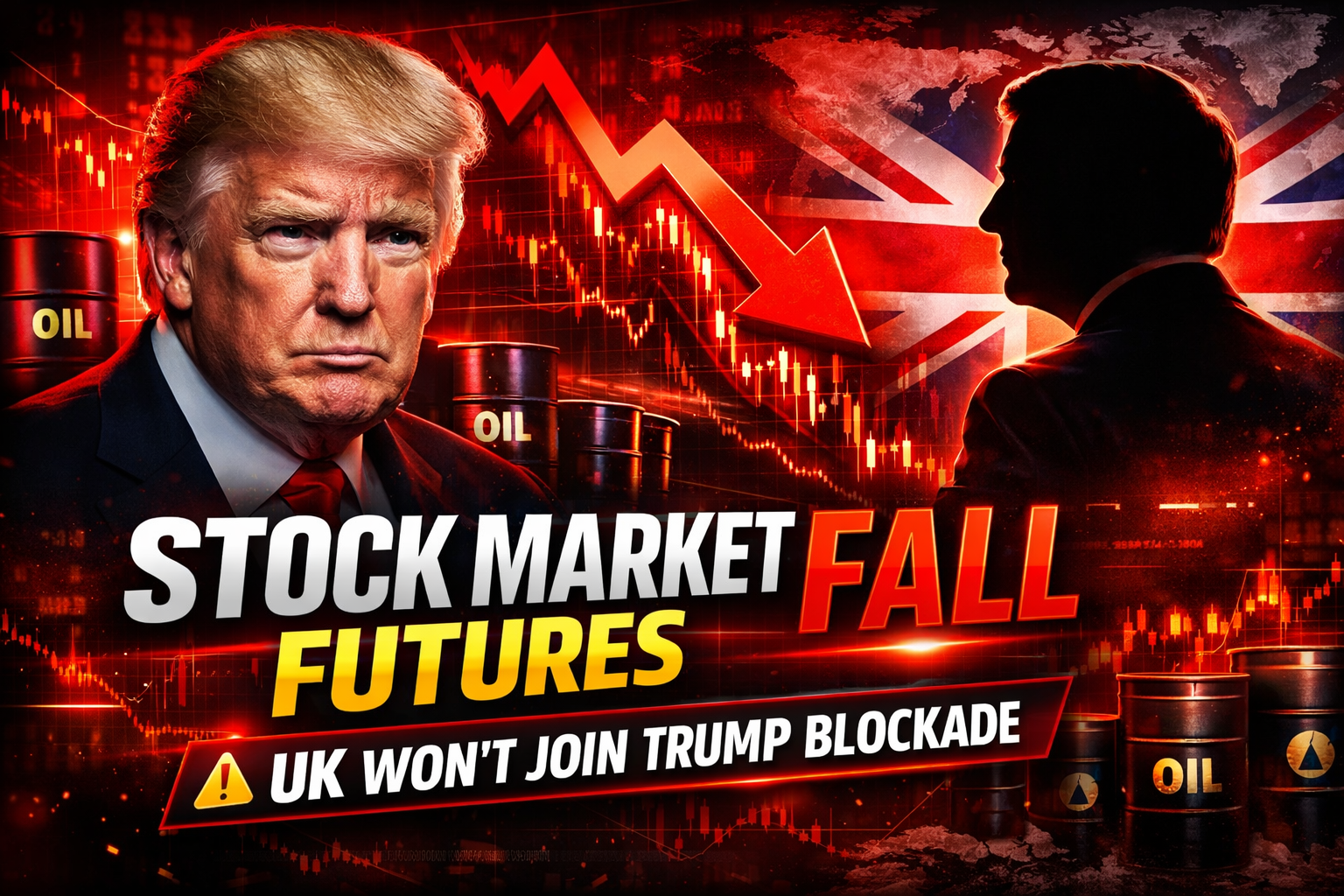
The move has rattled governments, unsettled investors, and sent stock market futures tumbling as fears grow that the conflict could spiral into a much larger regional crisis. Meanwhile, the United Kingdom has reportedly refused to participate in the blockade effort, creating new friction between Washington and its closest allies.
What was once expected to be a short and decisive confrontation is rapidly evolving into a drawn-out geopolitical and economic battle with global consequences. From rising oil prices to military risks and diplomatic fallout, Trump’s blockade strategy may prove to be one of the most consequential—and controversial—decisions of the year.
Let’s break down exactly what’s happening, why stock market futures are being hit so hard, and how this crisis could reshape the global economy.
Trump Doubles Down After Peace Talks Collapse
Weekend negotiations between US and Iranian officials in Islamabad ended without any breakthrough, dashing hopes of a diplomatic resolution to the conflict. The White House had entered the talks expecting Iran to accept sweeping concessions, including halting nuclear ambitions and reopening the Strait of Hormuz without restrictions.
But Tehran refused.
Iranian negotiators rejected Washington’s demands outright, insisting they would not surrender strategic leverage or admit defeat. That rejection left Trump with few alternatives.
Instead of returning immediately to diplomacy, Trump announced a bold military escalation: a blockade of the Strait of Hormuz aimed at choking Iran’s economy and cutting off its oil revenue streams.
Speaking to reporters, Trump described the strategy in blunt terms.
“It’s all in, all out,” he said. “There will be a time when we will have them all come in and all come out.”
However, the president provided few concrete details about how the blockade would function operationally, leaving analysts and allies scrambling for clarity.
Why the Strait of Hormuz Matters So Much
To understand why this move is causing panic, you need to understand the significance of the Strait of Hormuz.
The narrow waterway connects the Persian Gulf to the Arabian Sea and serves as one of the world’s most critical oil chokepoints. Roughly one-fifth of global oil passes through it every day.
That means if traffic is disrupted—even partially—it can send shockwaves through:
- Global energy markets
- Supply chains
- Inflation rates
- Consumer fuel prices
- International trade routes
Trump’s blockade proposal threatens to create exactly that disruption.
The US says the blockade will target traffic involving Iranian ports while preserving freedom of navigation for non-Iranian vessels. But in practice, enforcing that distinction could be extraordinarily difficult and dangerous.
Stock Market Futures Slide as Oil Prices Surge
Financial markets reacted instantly.
News of Trump’s blockade announcement sent stock market futures sharply lower as investors rushed to price in the risks of prolonged conflict and economic instability.
At the same time, Brent crude surged 8%, climbing above $104 per barrel almost immediately.
That spike matters enormously because higher oil prices ripple through every part of the economy:
- Transportation becomes more expensive
- Manufacturing costs rise
- Shipping rates increase
- Consumer prices go up
- Inflation worsens
For ordinary Americans, it likely means more pain at the gas pump.
Average gasoline prices have already climbed above $4 per gallon, and inflation recently accelerated from 2.4% to 3.3%. Rising oil costs could push those numbers even higher, creating serious political headaches for Trump heading into a crucial election season.
No wonder stock market futures traders are nervous.
UK Refuses to Join Trump’s Blockade Plan
One of the most striking developments in this crisis is the United Kingdom’s refusal to back Trump’s blockade.
United Kingdom has reportedly declined to participate militarily, distancing itself from Washington’s latest escalation and signaling growing discomfort among European allies over Trump’s handling of the war.
That refusal matters for several reasons.
First, it highlights increasing divisions within NATO, with allies frustrated by being drawn into conflicts they say they were not properly consulted about.
Second, it weakens the perception of international unity behind Trump’s strategy.
And third, it raises questions about whether America is becoming diplomatically isolated.
Trump has reportedly been furious over the lack of allied support, particularly from Europe, where leaders have criticized the administration for acting unilaterally.
The UK’s decision not to join may embolden other nations to resist involvement as well.
Trump’s Blockade Comes With Massive Risks
At first glance, blockading Iran’s oil routes may seem like a clever way to pressure Tehran without deploying ground troops.
But military experts warn the strategy carries enormous risks.
A blockade could:
- Trigger direct naval clashes between US and Iranian forces
- Make American warships vulnerable to missile or drone attacks
- Escalate into broader regional warfare
- Provoke attacks on US allies in the Gulf
- Create diplomatic crises with countries like China
In other words, it’s a gamble.
The US may hope the blockade pressures Iran economically enough to force concessions—but Tehran may instead respond aggressively.
And if that happens, the conflict could spiral quickly.
Iran Refuses to Back Down
Despite suffering extensive military damage during weeks of bombing, Iran insists it is not defeated.
Iranian officials argue the country still controls the Strait of Hormuz and retains strategic leverage.
Speaker of Parliament Mohammad Bagher Ghalibaf said Washington must decide whether it can “gain our trust” if it wants progress.
That statement reflects Iran’s broader position: it believes the US has failed to force surrender through military action and now lacks better options.
From Tehran’s perspective, the longer it holds out, the more political and economic costs the US bears.
And frankly, Iran may not be wrong.
Questions Grow Over What the War Has Actually Achieved
Trump initially portrayed the war as a rapid campaign designed to cripple Iran’s military, dismantle its nuclear ambitions, and eliminate regional threats.
US officials claim thousands of strikes have:
- Destroyed military infrastructure
- Weakened Iran’s navy
- Crippled air defenses
- Killed senior leaders
Yet despite all of that, Iran still refuses to yield.
Its enriched uranium stockpile reportedly remains partly intact, and its strategic position in Hormuz gives it new leverage over global trade.
That raises an uncomfortable question for Washington:
If Iran still won’t surrender after all this destruction, what exactly has been accomplished?
Critics argue the war has cost enormous resources without producing decisive strategic gains.
Trump Faces Political Pressure at Home
Foreign wars can quickly become domestic political liabilities.
Trump is now facing mounting pressure because:
- Inflation is rising
- Gas prices are climbing
- Consumer confidence is weakening
- Approval ratings are slipping
Americans may support military action in principle, but prolonged wars with no clear end tend to wear down public patience.
And if stock market futures continue falling while household expenses rise, the political backlash could intensify.
Trump campaigned heavily on promises of economic strength. A worsening economy tied to overseas conflict could undermine that message.
China and Global Powers Could Be Dragged In
Another danger? International escalation.
China relies heavily on Gulf oil imports, and any US attempt to interfere with Chinese-linked tankers could create a serious diplomatic crisis.
Trump had been preparing for a high-stakes summit with Chinese President Xi Jinping, but that meeting has already been delayed due to the war.
If the blockade disrupts Chinese shipping, relations between Washington and Beijing could deteriorate rapidly.
That would add another layer of volatility to already fragile global markets.
Critics Say Trump’s Strategy Makes Little Sense
Not everyone is convinced the blockade will even work.
Senator Mark Warner openly questioned the logic behind the plan, saying:
“I don’t understand how blockading the strait is going to somehow push the Iranians into opening it.”
That criticism reflects broader skepticism that Trump’s strategy is coherent.
Some analysts believe the blockade may worsen the situation without actually forcing Iran to change course.
Others see it as another example of impulsive policymaking driven more by optics than strategy.
Either way, the stakes are enormous.
What Happens Next?
That’s the billion-dollar question.
Several scenarios could unfold:
1. Iran Backs Down
Under economic pressure, Tehran could eventually agree to negotiations.
2. Military Escalation Intensifies
Iran may retaliate militarily, triggering a broader conflict.
3. Global Recession Fears Rise
If oil prices remain elevated, stock market futures could continue sliding and global growth may slow.
4. Diplomatic Pressure Forces Reversal
International backlash could push Trump to soften his position.
At the moment, none of these outcomes can be ruled out.
Conclusion
Trump’s decision to blockade the Strait of Hormuz marks a dramatic escalation in the US-Iran conflict and a risky new chapter in a war that has already proven far more complicated than expected. With diplomacy failing, allies like the UK refusing to join, and stock market futures falling amid fears of economic disruption, the administration now faces enormous pressure to show results.
Yet instead of delivering a decisive victory, the blockade may deepen the crisis—raising oil prices, straining alliances, and increasing the risk of broader war.
Trump may believe military pressure can force Iran into submission. But history has a way of humbling leaders who assume conflicts will end quickly and neatly.
And right now, this war looks anything but neat.
Final Thoughts
In the end, Trump’s blockade strategy may become a defining test of his presidency. If it works, he could claim victory and reshape the Middle East balance of power. But if it fails—or worse, triggers deeper conflict—it could damage the global economy, fracture alliances, and leave lasting scars on America’s international standing.
For now, one thing is clear: the world is watching, markets are trembling, and stock market futures remain the clearest sign that investors fear the worst may still be ahead.