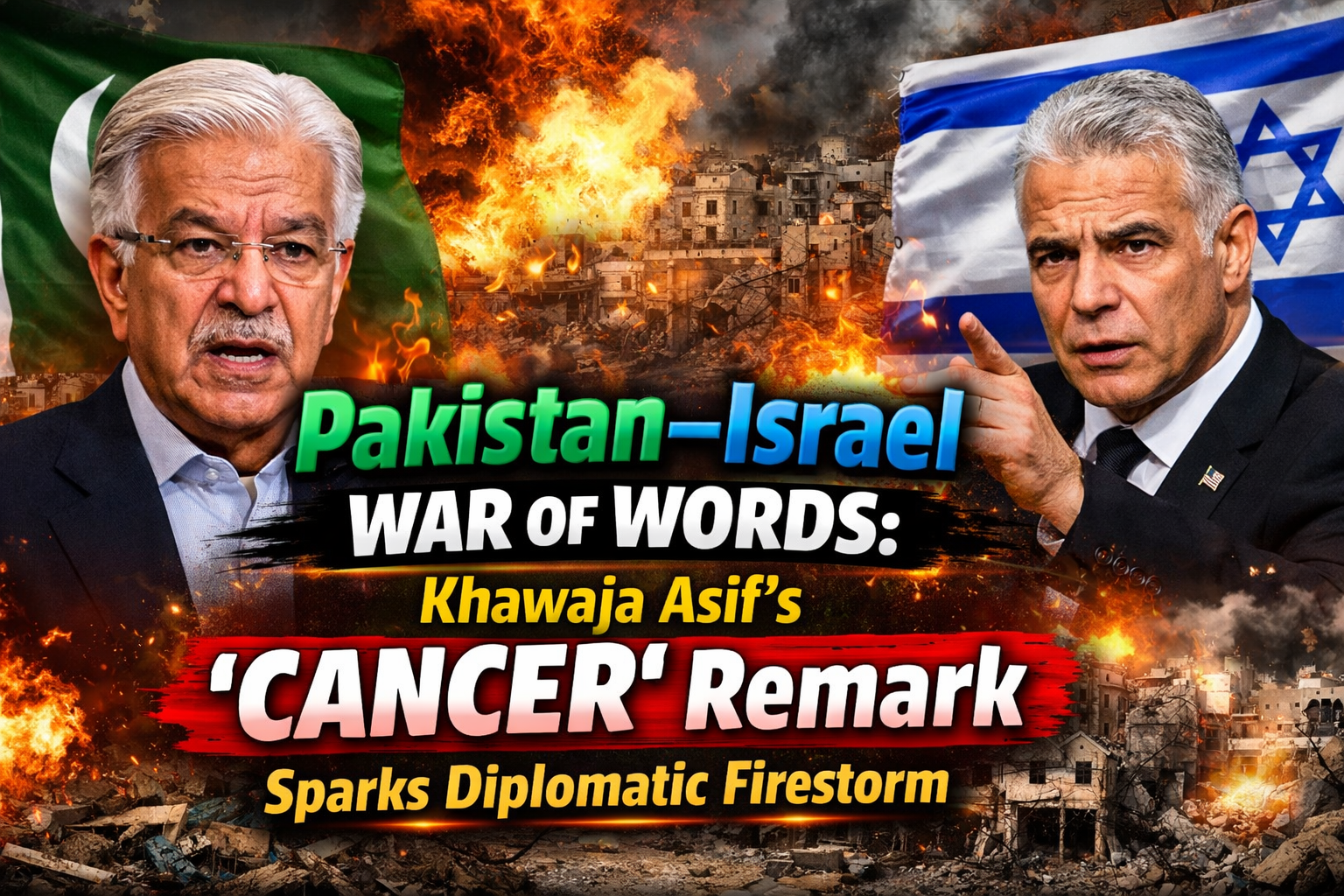
When diplomacy hangs by a thread, even a single sentence can shake the balance. That’s exactly what happened when Pakistan’s Defence Minister Khawaja Asif described Israel as a “cancer” and a “stain on humanity.” Within hours, the remark spiraled into a full-blown diplomatic controversy, drawing a sharp and immediate response from Israel.
But here’s the twist—Asif later deleted the post. Too late? In international politics, words once spoken often echo far beyond their deletion.
Let’s unpack what really happened, why it matters, and how it could reshape already fragile geopolitical equations.
The Controversial Statement: What Did Khawaja Asif Say?
On Thursday, Khawaja Asif took to social media platform X (formerly Twitter) and launched a scathing attack on Israel. His post didn’t hold back. He labeled Israel as:
- A “devil”
- A “stain on humanity”
- A “cancerous state”
He accused Israel of carrying out mass killings in Gaza and Lebanon, describing its actions as “unchecked bloodshed.” He also made a controversial historical reference, criticizing the creation of Israel on Palestinian land.
It wasn’t just criticism—it was language loaded with emotion, accusation, and political messaging.
So, why such strong words? And why now?
Timing Matters: Peace Talks in the Background
Interestingly, Asif’s remarks came at a sensitive moment. Pakistan was positioning itself as a mediator in a potential ceasefire between the United States and Iran.
Islamabad was preparing to host crucial talks involving representatives from both nations. Imagine trying to broker peace while simultaneously launching harsh rhetoric against one of the region’s most influential players—Israel.
It’s like trying to calm a fire while throwing sparks nearby.
Israel’s Strong Reaction: ‘Shameful and Unacceptable’
Israel didn’t stay silent. Its Foreign Minister Gideon Saar responded swiftly and firmly.
He described Asif’s comments as:
- “Shameful”
- “Reprehensible”
- “Openly antisemitic”
According to Saar, calling Israel a “cancer” is not just criticism—it implies a call for destruction. That’s a serious accusation in global diplomacy.
He also questioned Pakistan’s credibility as a peace mediator. After all, how can a country claim neutrality while using such charged language?
Deleted but Not Forgotten: Why Removing the Post Didn’t Help
Shortly after the backlash intensified, Khawaja Asif deleted the controversial post.
But here’s the reality of the digital age: screenshots are forever.
Deleting the post may have been an attempt to de-escalate tensions, but it also raised questions:
- Was it a moment of misjudgment?
- Or a calculated statement that backfired?
Either way, the damage had already been done.
Pakistan’s Diplomatic Position: Walking a Tightrope
Pakistan has long maintained a firm stance on Israel—it does not officially recognize the country and has no diplomatic relations with it.
This makes Islamabad’s role as a mediator even more complicated.
On one hand, Pakistan aims to present itself as a peacemaker in global conflicts. On the other, its historical and political stance against Israel remains deeply rooted.
It’s like trying to stand on two moving platforms at once—eventually, balance becomes difficult.
India’s Perspective: Trust Deficit Highlighted
The controversy didn’t stop there. In India, Israel’s ambassador made a pointed remark—Pakistan, he said, “cannot be trusted.”
Given India’s strong diplomatic and defense ties with Israel, such a statement carries weight.
It also reflects broader regional dynamics, where alliances and rivalries shape every narrative.
No Diplomatic Ties: A Long-Standing Divide
Let’s not forget—Pakistan and Israel don’t even officially recognize each other.
No embassies. No formal diplomatic channels.
This lack of engagement often leads to:
- Miscommunication
- Heightened rhetoric
- Limited conflict resolution mechanisms
In such a scenario, statements like Asif’s don’t just offend—they deepen an already wide divide.
The Middle East Factor: Gaza and Lebanon in Focus
At the heart of Asif’s criticism lies the ongoing conflict in Gaza and tensions in Lebanon.
Images of destruction, civilian casualties, and humanitarian crises have fueled strong reactions worldwide.
For many leaders, including Asif, these events demand vocal condemnation. But the tone and language used can determine whether criticism leads to dialogue—or conflict.
Mediator or Participant? Questions Over Pakistan’s Role
Pakistan’s attempt to mediate between the United States and Iran adds another layer to the story.
To be an effective mediator, a country must be seen as neutral and balanced.
But after such remarks, Israel—and possibly others—may view Pakistan as biased.
So, the question is: Can Islamabad still play the role of peacemaker?
Global Implications: Words That Shape Diplomacy
In international relations, language is power.
A single phrase can:
- Strengthen alliances
- Trigger conflicts
- Undermine negotiations
Asif’s statement is a textbook example of how rhetoric can ripple across borders, affecting not just bilateral ties but broader geopolitical strategies.
The Bigger Picture: Free Speech vs Diplomatic Responsibility
Here’s where things get interesting.
Leaders often walk a fine line between expressing national sentiment and maintaining diplomatic decorum.
Was Asif exercising free speech? Or did he cross a diplomatic red line?
In global politics, intent matters—but impact matters more.
Conclusion: A Lesson in the Power of Words
The controversy surrounding Khawaja Asif’s remarks is more than just a social media incident—it’s a reflection of deeper geopolitical tensions.
It highlights how fragile international diplomacy can be, especially in regions already burdened with conflict.
Deleting a post may remove it from a timeline, but it cannot erase its impact.
Final Thoughts: What Comes Next?
Will this incident fade away, or will it leave a lasting mark on Pakistan’s diplomatic ambitions?
That depends on what happens next.
Will Pakistan clarify its position?
Will Israel push for further accountability?
Or will global attention shift elsewhere, as it often does?
One thing is certain—when it comes to international relations, every word counts.
And sometimes, a single sentence can change everything.