
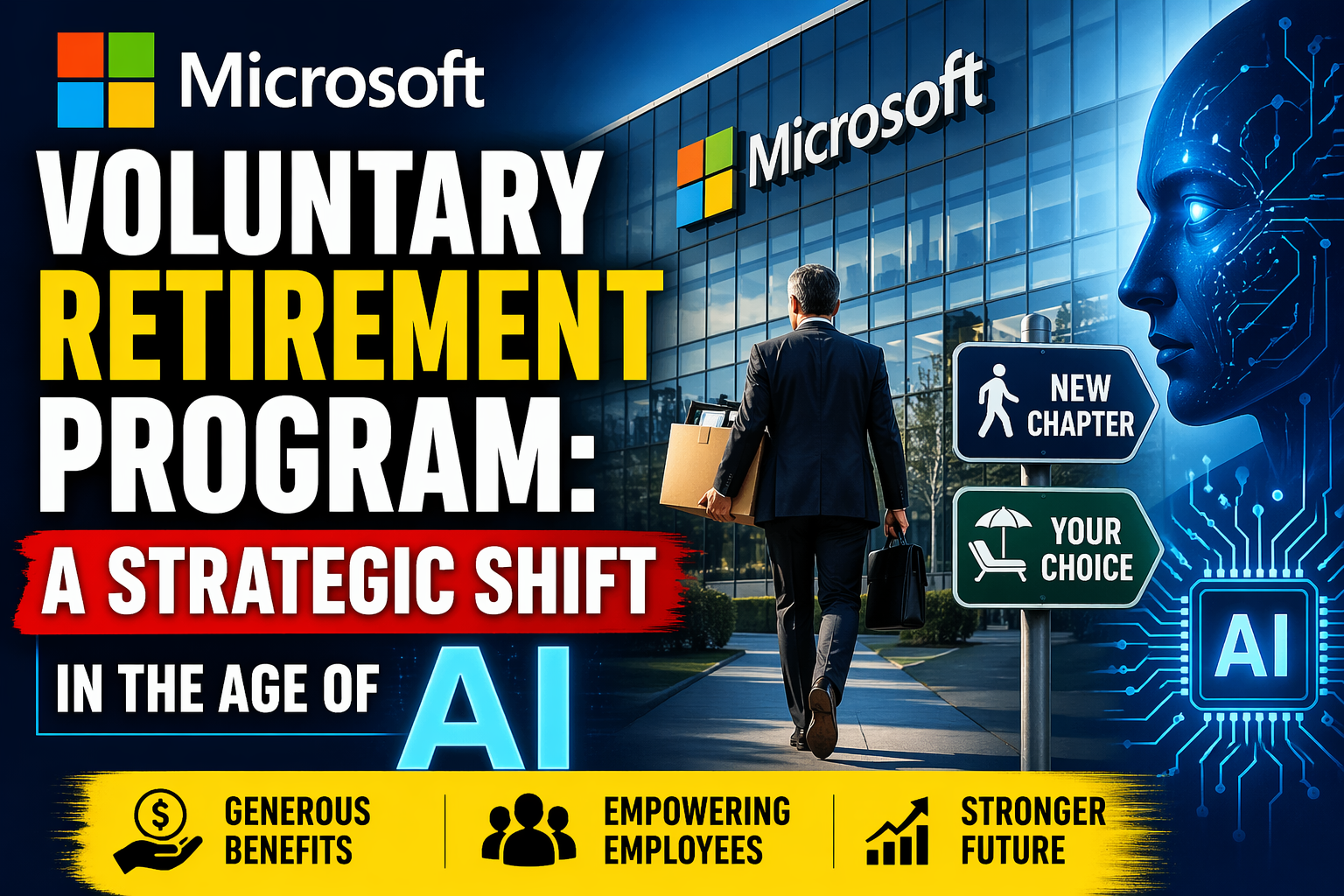
The tech world is changing fast—almost like trying to upgrade your phone while it’s still booting up. And right in the middle of this transformation, Microsoft has made a move that’s turning heads across the industry. For the first time in its 51-year history, the company is introducing a microsoft voluntary retirement program, offering buyouts to a segment of its U.S. workforce.
So what’s really going on here? Is this a quiet restructuring? A smart financial decision? Or a signal of deeper shifts driven by artificial intelligence?
Let’s break it all down in a way that actually makes sense.
What Is the Microsoft Voluntary Retirement Program?
At its core, the microsoft voluntary retirement program is a buyout initiative. Instead of laying off employees outright, Microsoft is giving eligible workers the option to leave voluntarily—with financial incentives attached.
Think of it like offering passengers a chance to step off a crowded train before it reaches the next station, rather than forcing them off abruptly.
This program is aimed at U.S.-based employees, particularly those in senior roles. It’s not mandatory. It’s not sudden. It’s structured, calculated, and—importantly—optional.
Who Is Eligible for the Program?
Not everyone at Microsoft can raise their hand and opt in. The eligibility criteria are quite specific:
- Employees must be based in the United States
- They should be at the senior director level or below
- Their age plus years of service must equal 70 or more
So, for example, someone who is 50 years old with 20 years at Microsoft would qualify.
However, there’s a catch: employees on sales incentive plans are excluded. That’s a clear signal that Microsoft wants to retain its revenue-driving workforce while offering exits elsewhere.
Why Is Microsoft Doing This Now?
Here’s where things get interesting.
The timing of the microsoft voluntary retirement program isn’t random. It’s happening during a massive transformation in the tech industry—driven largely by artificial intelligence.
Microsoft, along with competitors like Alphabet and Amazon, is pouring billions into AI infrastructure. That includes building data centers and expanding cloud capabilities to support advanced AI models.
But here’s the reality: these investments are expensive.
To balance the books, companies often look at operational costs—and salaries are one of the biggest.
So instead of aggressive layoffs, Microsoft is taking a softer approach. It’s essentially saying:
"If you’re ready to move on, we’ll support you in doing so."
The AI Boom Is Reshaping Everything
Let’s be honest—AI isn’t just a trend. It’s a tidal wave.
Companies like Anthropic are developing tools that can write code, automate workflows, and replace tasks that once required entire teams.
That means traditional roles are evolving—or disappearing altogether.
Microsoft knows this. And the microsoft voluntary retirement program is part of a broader strategy to reshape its workforce for the AI era.
It’s not just about cutting costs—it’s about reallocating talent.
How Many Employees Are Affected?
While Microsoft hasn’t officially disclosed the exact number, reports suggest that up to 7% of its U.S. workforce could be eligible.
To put that into perspective:
- Total employees (as of June 2025): 228,000
- U.S. workforce: 125,000
So we’re potentially talking about thousands of employees.
That’s not a small adjustment—it’s a significant shift.
Voluntary Buyouts vs. Layoffs: What’s the Difference?
You might be wondering: why not just do layoffs?
Here’s the difference:
Layoffs
- Immediate and often unexpected
- Can damage morale
- Create negative public perception
Voluntary Buyouts (like this program)
- Offer employees control
- Reduce legal and reputational risks
- Maintain a more positive company image
In simple terms, layoffs are like slamming the brakes. Buyouts are more like easing off the accelerator.
What’s Included in the Buyout Package?
Microsoft hasn’t publicly detailed every benefit yet, but typically, programs like the microsoft voluntary retirement program include:
- Financial compensation
- Extended healthcare benefits
- Retirement support
- Career transition assistance
The goal? Make the exit as smooth and attractive as possible.
As Microsoft’s Chief People Officer Amy Coleman put it, the intention is to allow employees to “take that next step on their own terms.”
A Shift in Employee Compensation Strategy
Interestingly, this program isn’t happening in isolation.
Microsoft is also changing how it rewards employees:
- Stock awards will no longer be directly tied to cash bonuses
- Managers will have more flexibility in performance recognition
- The review system is being simplified—from nine pay options to five
What does this mean?
It means Microsoft is trying to modernize not just its workforce—but its entire compensation philosophy.
How This Reflects Broader Tech Industry Trends
Microsoft isn’t alone in this approach.
Across Silicon Valley, companies are:
- Cutting costs
- Investing heavily in AI
- Streamlining operations
It’s like a massive industry-wide reset.
The difference is in execution. While some companies opt for mass layoffs, Microsoft is experimenting with a more controlled, voluntary approach.
That could set a precedent.
Employee Perspective: Opportunity or Uncertainty?
If you’re an employee, how would you feel?
Excited about a generous exit package?
Or worried about what this signals for the future?
The truth is—it’s both.
For some, the microsoft voluntary retirement program is a chance to:
- Retire early
- Start a new venture
- Pivot careers
For others, it raises questions about job security and long-term stability.
Investor Perspective: A Smart Financial Move?
From an investor’s standpoint, this move could be seen as strategic.
Why?
Because it:
- Reduces long-term salary obligations
- Frees up capital for AI investments
- Signals proactive management
In a market where software stocks are under pressure, this kind of cost optimization can boost confidence.
The Human Side of Corporate Strategy
Let’s not forget—behind every statistic is a person.
Every buyout offer represents a career, a story, a life transition.
And while the microsoft voluntary retirement program is a business decision, it also has a human impact.
That’s why the voluntary nature matters so much. It gives employees dignity and choice.
What Happens Next?
Eligible employees and their managers are expected to receive detailed information on May 7.
From there, the decision lies with the individuals.
Will they stay and adapt to the AI-driven future?
Or take the offer and move on?
It’s a crossroads moment.
Is This the Future of Workforce Management?
Here’s a thought: what if this becomes the new normal?
Instead of abrupt layoffs, companies might increasingly use voluntary programs to reshape their workforce.
It’s less disruptive. More strategic. And arguably more humane.
If Microsoft’s approach proves successful, don’t be surprised if others follow.
Conclusion: A Turning Point for Microsoft and the Tech Industry
The microsoft voluntary retirement program isn’t just a policy—it’s a signal.
A signal that:
- AI is reshaping the workforce
- Companies are rethinking how they manage talent
- The future of work is evolving faster than ever
Microsoft isn’t just reacting to change—it’s trying to get ahead of it.
And whether you’re an employee, investor, or observer, one thing is clear:
This is a pivotal moment.
Final Thoughts: Change Is the Only Constant
If there’s one takeaway from all this, it’s that change is inevitable.
The tech industry moves fast—sometimes faster than we’re ready for.
But programs like the microsoft voluntary retirement program show that change doesn’t have to be harsh. It can be thoughtful. Strategic. Even empowering.
So the real question is:
Are we ready to evolve with it?
Because whether we like it or not, the future isn’t waiting.