
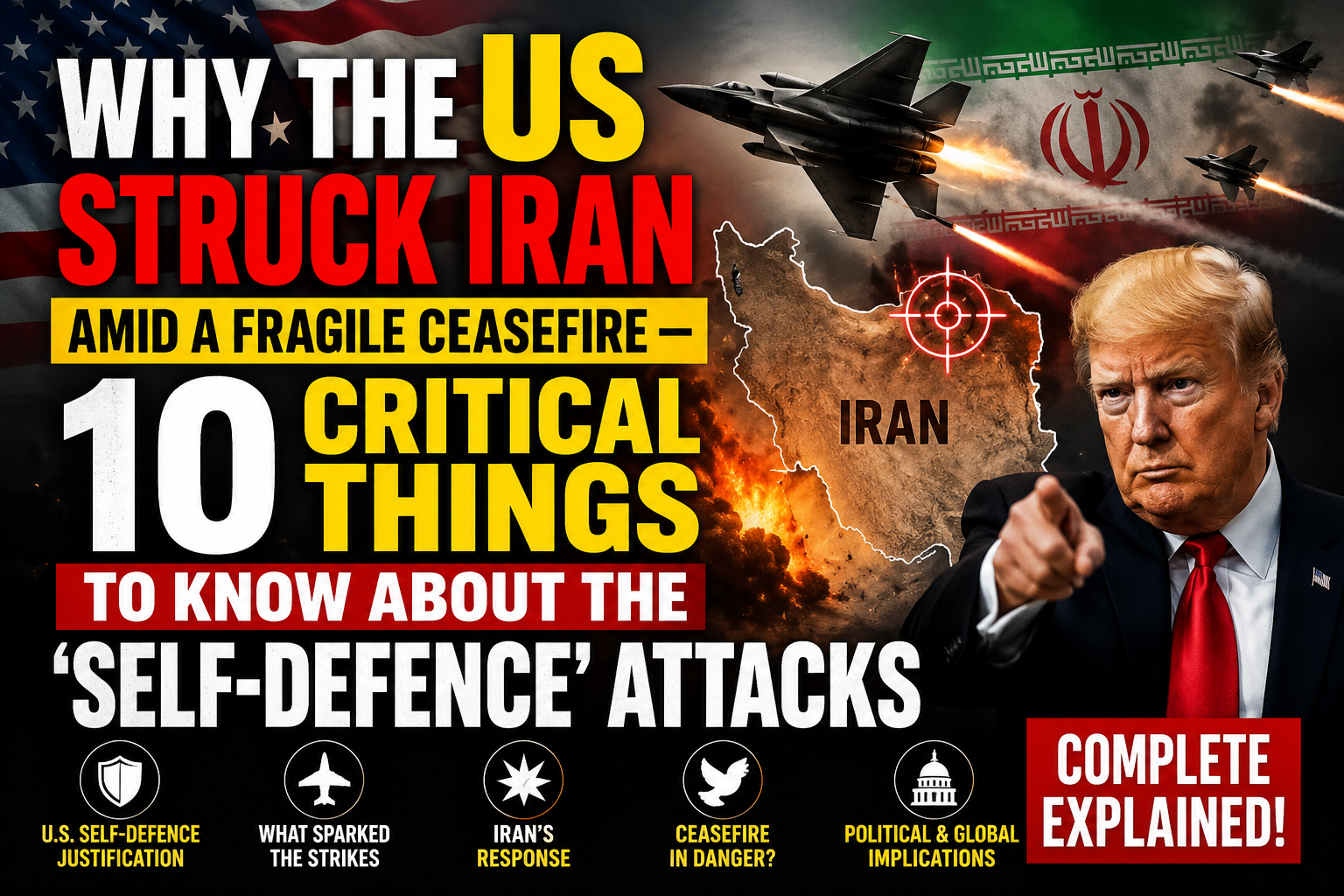
The already fragile relationship between the United States and Iran has once again moved dangerously close to the edge. Fresh US military strikes inside Iran — described by Washington as “self-defence” operations — have intensified fears that the uneasy ceasefire between the two nations could completely collapse.
At the center of this latest crisis are missile launch sites, naval activity near the Strait of Hormuz, and growing tensions over Iran’s enriched uranium stockpile. While diplomats continue trying to hammer out a peace agreement behind closed doors, explosions, accusations, and threats are once again dominating headlines across the Middle East.
So, why exactly did the US strike Iran now? What does it mean for the ceasefire? And could this trigger another major escalation in the already volatile region?
Here’s a detailed breakdown of the latest US Iran news and the 10 biggest developments shaping the current crisis.
The Ceasefire Between the US and Iran Was Already Hanging by a Thread
For weeks, the ceasefire between Washington and Tehran looked unstable. Both countries had agreed to reduce direct military confrontation after months of escalating attacks, cyber operations, and maritime threats.
But peace in the Middle East can sometimes feel like walking on cracked ice — one wrong move, and everything breaks apart.
The latest US strikes have now placed that ceasefire under enormous pressure. American officials insist the attacks were defensive in nature, while Iranian authorities see them as outright aggression.
Even as diplomats met in Doha to negotiate a possible long-term agreement, military action on the ground told a very different story.
Why the US Launched ‘Self-Defence’ Strikes Against Iran
According to US Central Command (CENTCOM), American forces targeted Iranian missile launch sites and boats allegedly trying to place naval mines near the Strait of Hormuz.
The US says the strikes were necessary to protect American personnel and safeguard one of the world’s most critical oil shipping routes.
CENTCOM spokesperson Capt Tim Hawkins explained that the strikes focused on immediate threats posed by Iranian military movements in southern Iran.
Washington claims the operations were measured and restrained, designed specifically to avoid broader escalation while still protecting US troops and international maritime traffic.
Still, Iran strongly disagrees with that explanation.
For Tehran, these attacks are further proof that the United States cannot be trusted during peace negotiations.
Donald Trump’s Uranium Warning Added Fuel to the Crisis
Just hours before the strikes, US President Donald Trump issued a fiery warning regarding Iran’s enriched uranium reserves.
Trump demanded that Iran either surrender its enriched uranium stockpile to the United States or destroy it under international supervision.
In a post shared on Truth Social, Trump stated that the uranium — which he dramatically referred to as “Nuclear Dust!” — must be eliminated as part of any future peace agreement.
His comments immediately intensified global attention on the ongoing nuclear dispute.
For years, Iran’s nuclear ambitions have been one of the biggest flashpoints in us iran war news coverage. Western governments fear Iran could eventually move closer to building nuclear weapons, while Tehran insists its nuclear programme is intended for peaceful purposes.
Trump’s hardline stance signals that Washington is unwilling to compromise on the nuclear issue anytime soon.
The Strait of Hormuz Remains the Most Dangerous Flashpoint
If the Middle East has a pressure valve, it’s the Strait of Hormuz.
This narrow waterway handles a massive percentage of the world’s oil shipments. Any disruption there instantly sends shockwaves through global energy markets.
US officials accused Iranian forces of attempting to lay sea mines in the strait — a move that could threaten international shipping and potentially cripple oil exports from Gulf nations.
That allegation appears to have been one of the biggest reasons behind the strikes.
Think of the Strait of Hormuz like a crowded highway carrying the world’s energy supply. Even a small blockage can create economic chaos across continents.
That’s why the US treats any perceived threat in the region as a serious security issue.
Peace Talks Were Happening in Qatar During the Strikes
Ironically, the military action happened while diplomatic negotiations were still underway.
Senior Iranian officials were reportedly in Doha, Qatar, discussing possible pathways to end the conflict with US representatives and regional mediators.
The talks reportedly focused on:
- Reopening the Strait of Hormuz
- Easing economic sanctions on Iran
- Managing Iran’s enriched uranium stockpile
- Preventing future military confrontations
This is what makes the latest developments so complicated.
On one side, diplomats are trying to build trust. On the other, missiles are flying and accusations are escalating.
That contradiction perfectly captures the current state of us iran relations.
Marco Rubio Says Diplomacy Still Has a Chance
Despite the strikes, US Secretary of State Marco Rubio insisted diplomacy remains the preferred path forward.
Speaking during a visit to New Delhi, Rubio said there was still a “solid” framework on the table that could lead to progress.
According to Rubio, discussions included:
- Reopening the Strait of Hormuz
- Launching formal nuclear negotiations
- Creating a time-limited diplomatic roadmap
However, Rubio also warned that if negotiations fail, Washington has “other ways” to deal with Iran.
That comment sent another clear message: diplomacy is still alive, but military pressure remains very much on the table.
And that balancing act — negotiation mixed with threats — has long defined the complicated history of iran us war tensions.
Explosions Rocked Bandar Abbas and Southern Iran
Soon after reports of the US strikes emerged, residents in several parts of southern Iran reported hearing loud explosions.
The port city of Bandar Abbas — strategically important because of its proximity to the Strait of Hormuz — became one of the key areas of concern.
Additional blast-like sounds were also reportedly heard near Sirik and Jask.
Iran-linked media outlet Fars News stated that the exact causes of the explosions were unclear. However, the timing strongly linked them to the reported US operations.
These incidents immediately triggered fears that broader military escalation could follow.
In volatile regions like the Persian Gulf, even limited military activity can spiral unexpectedly. That’s why global leaders are watching every development extremely carefully.
Deaths Reported on Larak Island Near the Strait of Hormuz
One of the most alarming developments involved reports of fatalities on Larak Island.
According to Iran International and local Iranian media reports, several people were killed during what was described as a joint US-Israeli strike near the Strait of Hormuz.
The victims were identified as:
- Abbas Eslami
- Ghodrat Zarangari
- Abdolreza Golzari
Some unconfirmed reports suggested possible ties between the victims and Iran’s Islamic Revolutionary Guard Corps (IRGC).
However, official confirmation remains limited.
These deaths have already added another emotional and political layer to the conflict. In situations like this, casualties often harden public opinion and make diplomatic compromise far more difficult.
Iran Accuses the US of Committing War Crimes
Iranian officials reacted furiously to the strikes.
Foreign ministry spokesperson Esmaeil Baghaei accused the United States of deliberately targeting civilians during previous military operations linked to the broader conflict.
Baghaei described missile attacks on residential areas and sports facilities, claiming that women, children, and teenage volleyball players were among the victims.
He argued the attacks were not accidental and labelled them “war crimes.”
Iran also alleged that US missiles released thousands of tungsten fragments, causing widespread injuries and long-term disabilities.
These accusations significantly raise the stakes diplomatically.
Once terms like “war crime” enter the conversation, negotiations become even more difficult because the issue shifts beyond military strategy into legal and moral territory.
Iran Claims It Shot Down a Stealth Drone
Iranian media also claimed the country successfully intercepted and destroyed a hostile stealth drone using a newly deployed air defence system.
Officials described the incident as proof that Iranian skies are no longer vulnerable to advanced surveillance technology.
Although Iran did not publicly identify the drone’s origin, the announcement appeared aimed at both the US and Israel.
Whether fully accurate or partly symbolic, such claims matter politically.
In modern warfare, perception can sometimes be just as important as reality. Demonstrating military capability helps governments project strength both domestically and internationally.
A New Plan Could Reopen the Strait of Hormuz
Amid the tension, a potentially important diplomatic proposal has emerged.
According to reports citing Middle Eastern diplomatic sources, the US and Iran are discussing a framework to reopen the Strait of Hormuz roughly 30 days after a formal peace agreement is reached.
The proposal reportedly includes:
- Iran removing naval mines from the waterway
- Safe passage guarantees for international ships
- Removal of Iranian transit charges
- International monitoring mechanisms
If implemented, this could help reduce tensions significantly.
Why does that matter? Because the Strait of Hormuz isn’t just a regional issue — it affects global oil prices, international trade, and economic stability worldwide.
Any lasting peace agreement would almost certainly need to address maritime security first.
Analysts Believe the Strikes May Have Been Strategic Intelligence Operations
Some military analysts believe the US strikes were not purely retaliatory.
Former US diplomat and Pentagon official Adam Clements suggested the operations may also have been connected to intelligence gathering related to Iran’s naval and missile capabilities.
Speaking to media outlets, Clements argued that the US likely acted because it believed Iranian activity near the Strait of Hormuz posed a serious threat.
He added that Iranian attempts to place mines would almost certainly provoke a strong American military response.
This theory paints the strikes as part military action, part strategic signalling.
In other words, Washington may have wanted to send a message: the US is willing to act quickly if maritime security is threatened.
Trump Wants to Expand the Abraham Accords
As if the situation were not already complicated enough, Trump also proposed expanding the Abraham Accords during the ongoing negotiations.
The Abraham Accords were originally designed to normalize diplomatic relations between Israel and several Arab nations.
Trump is now reportedly encouraging countries including:
- Saudi Arabia
- Qatar
- Pakistan
- Turkey
- Egypt
- Jordan
to join the framework.
Supporters argue that broader regional cooperation could reduce long-term instability.
Critics, however, warn that pushing normalization with Israel during sensitive US-Iran negotiations could inflame tensions even further.
For Iran, the expansion of such alliances may be viewed as a direct strategic challenge.
Could the US-Iran Ceasefire Collapse Completely?
That’s the question hanging over the entire region right now.
On paper, diplomacy is still alive. Negotiators continue meeting. Discussions are ongoing. Proposals are still being exchanged.
But trust between Washington and Tehran remains dangerously low.
Every explosion, every missile strike, every accusation, and every warning pushes both sides closer to renewed confrontation.
The situation feels like a chess match being played on a battlefield. One wrong calculation could trigger a much larger regional crisis involving multiple countries.
And with the Strait of Hormuz, global oil markets, and nuclear tensions all connected to the dispute, the consequences would stretch far beyond the Middle East.
Conclusion
The latest chapter in the escalating us iran news cycle shows just how fragile peace in the Middle East remains. While the United States insists its recent strikes were defensive operations aimed at protecting troops and international shipping routes, Iran sees the attacks as dangerous aggression that could destroy ongoing peace efforts.
At the heart of the crisis are nuclear tensions, maritime security threats, regional alliances, and deep-rooted mistrust that has defined us iran war relations for decades.
For now, diplomacy is still breathing — but barely.
Whether negotiations succeed or fail may depend on what happens next in the Strait of Hormuz, at the negotiating table in Doha, and inside the increasingly tense political calculations of both Washington and Tehran.
The world is watching closely because if this fragile ceasefire breaks completely, the consequences could reshape the Middle East once again.